

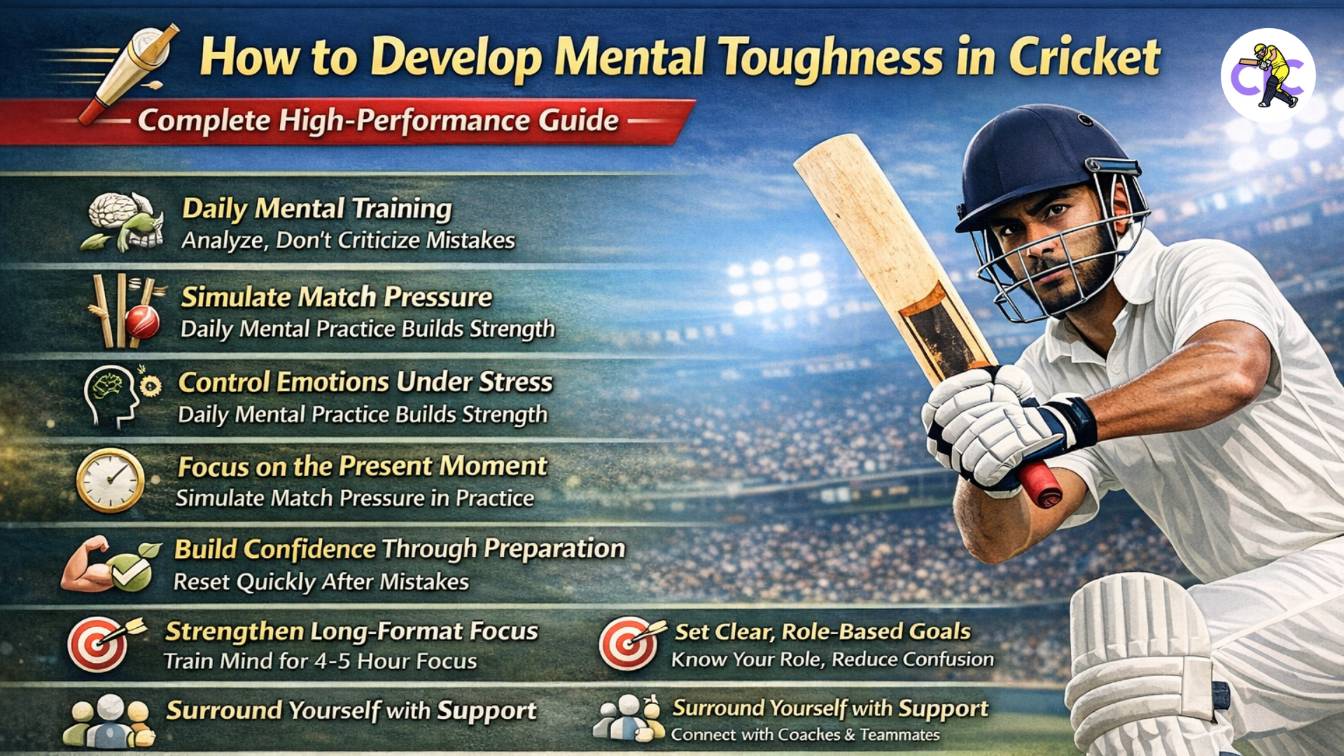
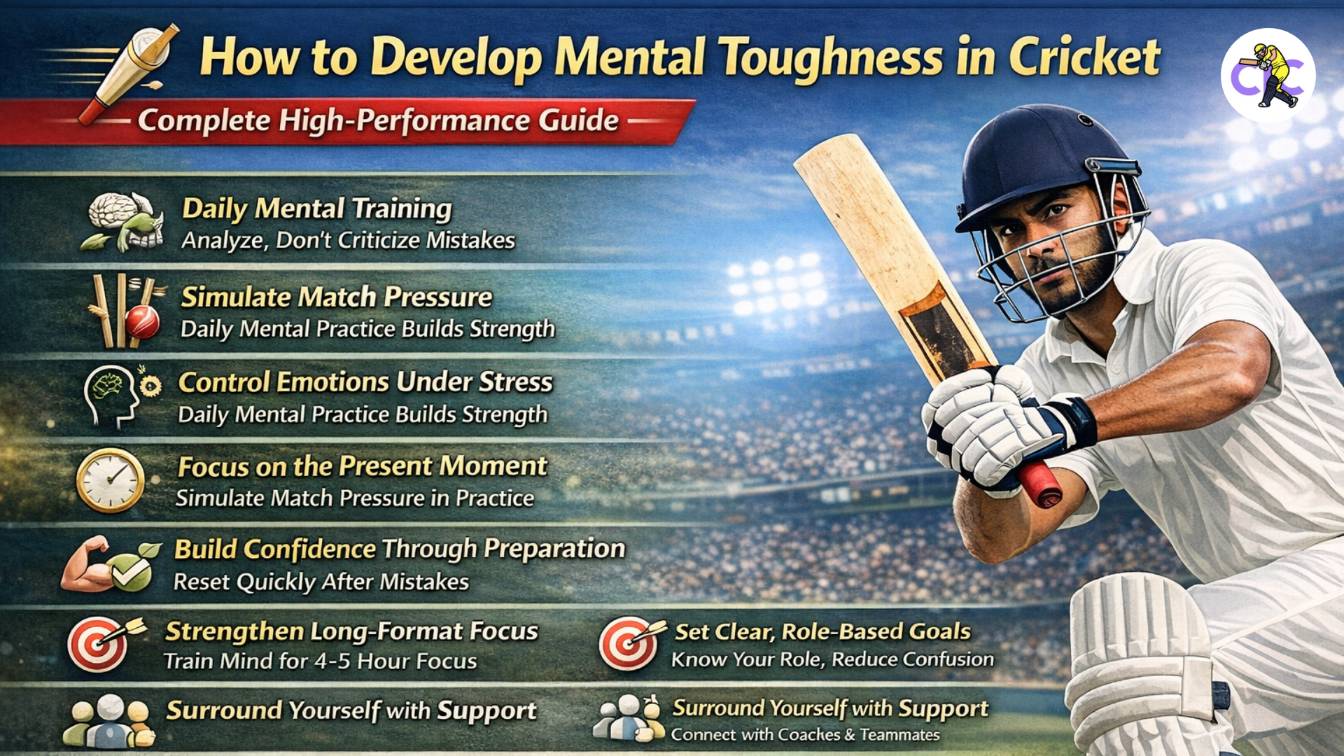
Cricket is often described as a mental game disguised as a physical sport. Skill is important, fitness is essential, but mental strength is what separates good players from great players. Many cricketers perform well in practice but struggle when facing pressure during matches. The difference is rarely technical — it is psychological.
Mental toughness in cricket means staying calm under pressure, maintaining focus for long periods, recovering quickly from setbacks, and performing consistently despite challenges. In competitive cricket, especially at district, state, or professional levels, mental resilience becomes just as important as technique.
This complete guide explains how you can systematically develop mental toughness and build a stronger cricket mindset.
Read more: Pressure Situations Me Run Kaise Banaye? Mental Training for Batters
Understanding Mental Toughness in Cricket
Mental toughness is the ability to:
Stay composed in high-pressure situations
Handle failure without losing confidence
Maintain discipline over long formats
Control emotions during intense moments
Make smart decisions under stress
In cricket, one mistake can change a match. A batter might leave one loose delivery and get bowled. A bowler might lose rhythm after being hit for boundaries. A fielder might drop a catch and struggle to recover. Mentally strong players reset immediately and move forward.
1️⃣ Build Resilience Through Failure
Failure is unavoidable in cricket. Even world-class players fail more often than they succeed. A batter may score big once but get out cheaply in several innings. A bowler may have a brilliant spell in one match and struggle in the next.
Mental toughness begins when you:
Accept failure as part of growth
Analyze mistakes calmly
Focus on improvement instead of blame
Instead of reacting emotionally, ask yourself:
What went wrong?
What can I control next time?
This mindset builds long-term resilience.
2️⃣ Train Your Mind Like You Train Your Body
Most players spend hours practicing skills but ignore mental training. Mental toughness improves with deliberate practice.
Daily mental training habits:
5–10 minutes of breathing exercises
Short meditation sessions
Visualization of match situations
Positive affirmation practice
Visualization is especially powerful. Before a match, imagine yourself:
Playing confidently against fast bowling
Executing yorkers under pressure
Taking clean catches in crucial moments
Your brain begins to recognize success as familiar.
3️⃣ Develop Pressure Tolerance Through Simulation
Pressure should not be a surprise during matches. It should feel familiar.
You can create pressure in practice by:
Setting run targets with limited balls
Practicing death overs repeatedly
Creating match-winning scenarios
Adding consequences in practice matches
For example:
“Score 15 runs in the last over.”
“Defend 8 runs in 6 balls.”
The more you practice under pressure, the more comfortable you become.
4️⃣ Master Emotional Control
Cricket tests emotions constantly. After a bad decision, a dropped catch, or an unlucky dismissal, frustration can affect the next performance.
Mentally tough players:
Control their body language
Avoid aggressive reactions
Reset quickly after mistakes
One powerful technique is the “reset routine.” After every ball, take a deep breath, walk away briefly, and refocus.
Never allow one mistake to control the next ball.
5️⃣ Focus on the Present Moment
Overthinking destroys performance.
Common distractions include:
Thinking about selection
Worrying about scores
Fear of failure
Social media pressure
Strong players focus on:
One ball at a time
One over at a time
One session at a time
When you narrow your focus to the present, anxiety reduces and clarity improves.
6️⃣ Strengthen Self-Belief Through Preparation
Confidence is built through preparation.
If you:
Train regularly
Maintain fitness
Practice match scenarios
Understand your role
Your self-belief naturally grows.
Doubt often comes from lack of preparation. When preparation is strong, confidence becomes stable.
7️⃣ Improve Concentration for Long Formats
In longer formats like red-ball cricket, concentration must last for hours. Losing focus for a single delivery can cost a wicket.
To improve concentration:
Practice long batting sessions
Avoid distractions during nets
Follow structured routines
Improve sleep and recovery
Mental stamina is just as important as physical stamina.
8️⃣ Set Clear Role-Based Goals
Unclear roles create confusion and anxiety.
Know your role:
Are you an opener who builds innings?
A finisher who accelerates?
A defensive bowler or attacking bowler?
When role clarity exists, decision-making improves and confidence increases.
9️⃣ Surround Yourself With Positive Influence
Your environment impacts your mindset.
Stay connected with:
Supportive coaches
Motivating teammates
Constructive mentors
Avoid negative comparisons and toxic criticism. Constructive feedback builds strength; constant negativity weakens confidence.
🔟 Develop Long-Term Patience
Cricket careers take time. Immediate success is rare.
Mental toughness grows when you:
Stay committed to routine
Continue training during tough phases
Avoid quitting after setbacks
Understand that progress is gradual
The strongest cricketers are those who persist through difficult seasons.
Physical Fitness and Mental Stability Connection
There is a strong link between fitness and mental strength.
When you are physically fit:
You handle fatigue better
Your confidence improves
Stress reduces
Decision-making becomes sharper
Strong body supports a strong mind.
How Career in Cricket (CIC) Supports Mental Development
Career in Cricket (CIC) emphasizes complete player development, including mental resilience. It focuses on:
Performance awareness
Selection-focused preparation
Pressure management education
Structured career clarity
The goal is to help players become mentally prepared for real competitive cricket.
Final Summary
Mental toughness in cricket is not natural talent — it is developed through structured effort.
You build mental strength by:
✔ Accepting failure calmly
✔ Practicing under pressure
✔ Controlling emotions
✔ Strengthening concentration
✔ Maintaining physical fitness
✔ Following consistent routines
Skill may win moments, but mental toughness wins careers.
If you train your mindset daily, just like your batting or bowling, you gain a long-term competitive advantage.
Read more: India Me Professional Cricketer Banne Ka Process – Detailed & Reality-Based Guide
Read more: Selectors Aaj Kal Talent Kaise Judge Karte Hain? Modern Cricket Selection Reality


